There is a shift happening across manufacturing floors today. It does not announce itself loudly. It starts with a single workflow that becomes automated, a routine movement handled by a machine instead of a person, an ordinary process that suddenly becomes effortless. And then one day you look up and realize something subtle but powerful has changed, the future of AI in manufacturing. The future has arrived quietly, and it is not turning back.
This transformation is being led by AI in manufacturing systems like the Model C2 Autonomous Mobile Robotic Cart. The rise of AI in manufacturing is not a vague prediction. It is not something that will appear in five or ten years. It is happening now. And for the companies that adopt it early, everything about how they operate begins to evolve.
How AI is Rewriting the Manufacturing Playbook
Historically, automation meant fixed machinery that did one task over and over. But the new generation of AI-powered systems thinks, responds, adapts, and improves. The heart of this shift is machine intelligence, which allows robots to make decisions in real time instead of relying on rigid programming.
In practice, this means a machine can understand its surroundings, anticipate obstacles, adjust its route, and complete tasks with consistency. It can take in new information constantly and update its behavior. It is automation that learns.
The result is a manufacturing environment that is no longer defined by static workflows. Instead, facilities are becoming dynamic systems where humans and machines collaborate. AI is not replacing workers; it is removing the friction that slows them down and lifting the burden of repetitive movement so they can focus on work that actually matters.
This is where the Model C2 comes in.
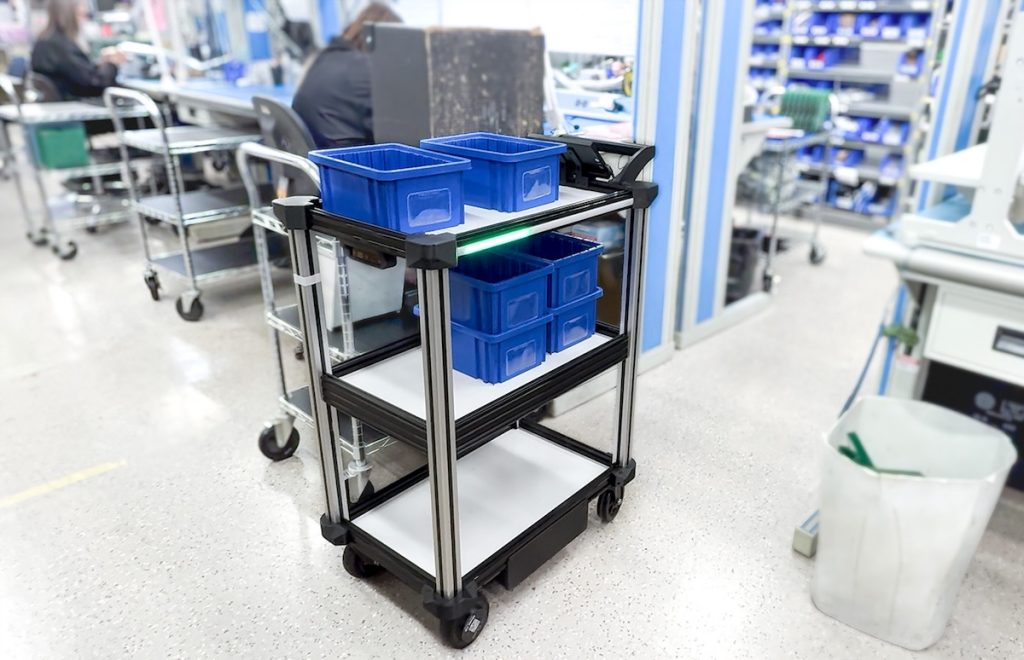
The First Real Taste of the AI-Supported Floor
For many companies, the Model C2 is the first introduction to what true AI-enabled automation feels like. The first time teams watch it move independently across the floor, stop safely, adjust its course, or return for its next task without being told, they realize the old way of doing things is no longer the benchmark.
At first, people gather around it with fascination. They track its route, test its sensors, and follow its decisions with curiosity. But as days pass, something remarkable happens. The novelty fades, and the C2 becomes part of the daily rhythm. It is accepted not as a shiny new tool but as a dependable member of the team.
The C2 handles the back-and-forth material movement that once drained hours from the day. And the workers who used to push carts nonstop begin using that time to improve processes, manage inventory, solve unexpected problems, or develop new skills.
AI does not remove the human role. It elevates it.
Automation Is Filling Gaps, Not Jobs
There is an ongoing belief in manufacturing that robots will take the place of workers. But the reality across most facilities is very different. Skilled workers are retiring faster than they can be replaced. Material handlers and internal movers are increasingly difficult to hire and even harder to keep. These positions often have high turnover because the work is repetitive and physically demanding.
The Model C2 steps into this gap and carries the weight that no one is available or eager to carry. It moves materials safely and reliably. It keeps production flowing. And it makes the existing workforce more productive without requiring teams to expand in ways that are not feasible.
AI is not eliminating opportunity. It is preserving it.
The Real Impact of AI is Stability
For manufacturers, the greatest benefit of AI robotics is consistency. Human focus fluctuates. Fatigue happens. Distractions occur. But an intelligent cart like the C2 performs with the same precision at any hour and on any shift. That stability allows managers to plan production with more confidence and less doubt. It reduces bottlenecks. It prevents slowdowns.
But the bigger change is cultural. Once teams are freed from the physical repetition of pushing carts, they begin to think differently about the entire operation. They start rearranging floor layouts to support flow, identify unnecessary steps, and spot patterns that were invisible before.
AI does not just automate the work. It inspires a smarter workplace.
Building a Tool Designed for Humans
The Model C2 was never meant to replace a person. It was built to work seamlessly alongside them. That is why the design focuses on adaptability, safety, and intuitive interaction. The C2 understands the noise and motion of a real manufacturing environment. It interprets human movement and adjusts accordingly, and navigates through mixed traffic with confidence.
It feels less like a machine and more like a partner. A machine that is always ready for the next load. A partner that does not lose energy, lose focus, or need direction. A partner that quietly strengthens the entire operation.
And something interesting happens over time. Teams begin referring to the C2 as part of “us.” Not as a tool they use but as a teammate that supports everything they do. That shift marks the moment when AI is no longer futuristic. It is foundational.
Once You See What AI Can Do, You Cannot Unsee It
There is a reason companies do not revert after adopting AI automation. Once they experience a smooth, predictable, and stable workflow, the manual version feels unthinkable. AI enables teams to redirect their attention to higher-level work, fundamentally changing the job’s identity.
It reduces strain. Also, creates space for creativity, planning, and leadership. Additionally, transforms manufacturing from purely physical labor into a blend of human ingenuity supported by machine precision.
And it is only the beginning.
A Future Built on Shared Strength
The next era of manufacturing will not be defined by choosing between humans and robots. It will be defined by teams that use AI to extend their capabilities. Just as calculators expanded the reach of mathematicians, AI robotics expands what manufacturing teams can achieve.
The Model C2 represents this shift in real time. It is a tool that supports the workforce, strengthens production, and prepares companies for the new expectations of speed and reliability that define modern operations.
The future of manufacturing is not approaching. It is already on the floor, moving from task to task, learning, adapting, and opening new possibilities every day.
And once you experience that future firsthand, you understand something very clearly:
We are not going back.
We are moving forward.
Our Website: https://www.quasi.ai/
Find Us on LinkedIn: https://www.linkedin.com/company/quasi-robotics/