When people first encounter the Model C2 Mini, the reaction is nearly universal:
“How is all of this even possible in something so small?”
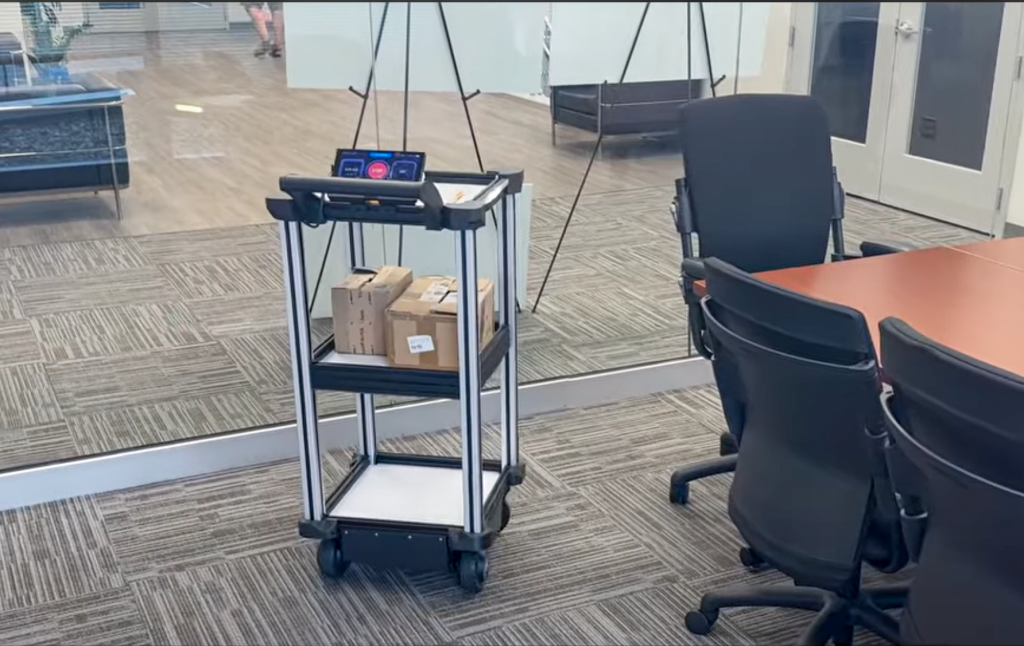
At first glance, the C2 Mini looks almost unreal. It is an autonomous mobile robot with a 350 mm × 350 mm footprint, full navigation autonomy, a touchscreen UI, excellent battery life, smooth drive performance, and enterprise-grade safety. All electronics are packed under a compact lower shelf and wrapped into a quiet, elegant, office-friendly platform.
Today, we are opening the hood both literally and figuratively to show how Quasi Robotics engineers made this miracle of miniaturization real.
Extreme Density Engineering
Everything Under One Shelf
Nearly all electronics, the drivetrain, the battery, motor controllers, power systems, and sensor interfaces live within the tight space under the lower shelf of the C2 Mini.
To appreciate how dense this is, consider the constraints.
Footprint
- 350 mm × 350 mm
Space is also required for
- Two 5-inch powered drive wheels
- Two 5-inch 360° casters
- Full battery pack
- All cables, housings, and connectors
- Thermal ventilation corridors
- CPU module
- MCU cluster
- LIDAR and sensor control boards
- Motor drivers and power distribution board
Most AMRs that offer similar capabilities are two to four times larger. C2 Mini’s compactness is not an incremental improvement. It is a full architectural rethinking of how an AMR should be built.
Battery Life
12 to 16 Hours on a Platform Half Filled by the Battery
Here is the surprising part. The battery alone consumes almost half of the internal volume, yet C2 Mini still delivers 12 to 16 hours of continuous operation.
So how does it do that?
The instinctive answer, a bigger battery, is wrong.
The real answer lies in Quasi Robotics’ ultra-high efficiency compute architecture, where every milliwatt matters.
The Secret
One CPU and 15+ Microcontrollers
At the center of C2 Mini is a tiny CPU module roughly the size of a deck of cards.
This single CPU runs:
- The core operating system
- Navigation services
- Localization
- Route planning AI
- The touchscreen user interface
- Fleet communication services
Everything else, the heavy lifting tasks normally handled by the main CPU, is delegated to a distributed network of more than 15 low-power microcontrollers.
These microcontrollers handle:
- Motor control loops
- LIDAR acquisition
- IMU and sensor fusion
- Obstacle detection preprocessing
- Power management
- Battery telemetry
- IO communication
- Safety interlocks
- Peripheral tasks
Most robotics companies run all of these systems on the main CPU, which increases power draw, heat dissipation, and system size.
At Quasi, we do the opposite.
We offload nearly everything to microcontrollers.
Our engineering team specializes in C and C++ for bare metal and RTOS-based MCU programming. The result is an orchestration of dozens of tiny, extremely efficient computers, each doing one job exceptionally well while using only milliwatts of power.
This architecture is the real reason Model C2 AMRs can run for up to 16 hours straight.
Thermal Management
Low Voltage, Low Current, Zero Noise
The entire electrical system operates at 24 volts, with peak loads rarely exceeding 5 to 7 amps, even when climbing a ramp with a full payload.
This delivers several major advantages:
- Minimal heat generation
- Smaller power components
- Longer electronics lifespan
- Silent operation
- Safer voltage for technicians
- More efficient energy usage
When combined with the microcontroller-centric design, the Mini practically sips power, producing almost no heat. This is essential in a tightly packed platform where airflow is limited.
An AMR You Need to Experience to Believe
Specs tell only part of the story.
To truly understand the C2 Mini, you need to experience its:
- Ultra-smooth acceleration profiles
- Quiet, whisper-level operation
- Natural, gentle, human-centric movements
- Unparalleled obstacle avoidance and turning radius
- Intuitive 8-inch touchscreen interface
- Remarkably compact footprint that fits anywhere
The Mini is purpose-built for office environments, labs, hospitality, and human dense spaces where size, noise, and motion dynamics matter as much as raw capability.
Conclusion
Engineering Without Compromise
Model C2 Mini is more than a small AMR.
It is a demonstration of what happens when robotics is rethought from the ground up:
- Distributed compute architecture
- Extreme space optimization
- Ultra-low power design
- Advanced microcontroller firmware
- Elegant mechanical engineering
- High efficiency 24V power system
- Compact, approachable form factor
At Quasi Robotics, we did not shrink an AMR. We reinvented one.
If you work in environments where space and silence matter, or if you want to see true engineering craftsmanship packed into a 350 × 350 mm footprint, you will be impressed with Mini.
Come see it in person. It is an experience no spec sheet can fully capture.
Our Website: https://www.quasi.ai/
Find Us on LinkedIn: https://www.linkedin.com/company/quasi-robotics/