At the heart of every Model C2 Autonomous Mobile Robot lies Q.AI, Quasi’s proprietary intelligence engine. Q.AI is not a single monolithic AI model, nor is it a black box neural network trained on massive datasets. Instead, it is a carefully designed orchestration of specialized algorithms running efficiently, additionally across microcontrollers and processors. Here’s a look at Q.AI, the Algorithmic Intelligence for the Model C2.
The result is predictable, explainable, and remarkably intelligent behavior in real-world industrial environments.
This philosophy of algorithmic intelligence over statistical guesswork has defined Q.AI from the very beginning.
An Algorithmic Foundation Built Over Time
Development of Q.AI began in 2018, long before AI became a marketing buzzword. From the outset, Quasi’s founders were deeply influenced by Peter Norvig and Stuart Russell’s work Artificial Intelligence A Modern Approach.
One core idea stood out clearly. Intelligence emerges from the interaction of multiple well designed algorithms, each solving a specific problem domain.
Rather than relying on heavy machine learning models that require constant retraining and massive computational resources, Q.AI is built on lightweight, efficient, and specialized algorithms.
In practice, seven to ten algorithms work together to handle perception, localization, motion planning, obstacle avoidance, task execution, safety logic, and system health monitoring. Together, they demonstrate behavior that appears intelligent, adaptive, and purposeful.
Algorithmic systems understand why they act and can explain, reproduce, and validate those actions.
Microcontroller Orchestration Intelligence at the Edge
One of the defining characteristics of Q.AI is its microcontroller centric architecture. Instead of pushing all computation to a single high power CPU, Q.AI distributes responsibility across multiple microcontrollers.
Motor control, sensor fusion, LiDAR processing, safety monitoring, battery management, and real time decision loops are handled locally by dedicated controllers programmed in C and C++.
This allows Q.AI to react deterministically and in real time, which is critical for safe autonomous navigation.
The result is a parallel architecture where each component does exactly what it is best suited for. The central processor orchestrates decisions, while microcontrollers execute them with precision and reliability. This reduces CPU requirements, lowers power consumption, and improves overall system robustness.
A Layered Architecture Designed for Flow
Q.AI sits at the top of a carefully layered software stack.
Core Operating System
Ubuntu Linux provides a stable industrial-grade foundation.
Middleware
ROS 2 enables structured communication between sensors, controllers, and services.
Top Layer
Q.AI algorithms interpret data, make decisions, and coordinate actions.
This layered approach ensures a smooth and predictable flow of data from perception to action. Because computation is distributed and parallelized, Model C2 achieves fluid navigation, reliable obstacle avoidance, and consistent performance even in complex and dynamic environments.
The low computational footprint also means fewer thermal constraints, lower hardware costs, and long operational lifetimes.
Validatable Intelligence: A Critical Advantage
Unlike many AI systems, Q.AI is fully validatable.
Because Q.AI’s behavior is deterministic and predictable, its decision-making can be tested, documented, and validated. This is a major advantage for customers operating in regulated industries such as life sciences, healthcare, and pharmaceutical manufacturing.
Facilities that require formal validation, including IQ, OQ, and PQ processes,s benefit from Q.AI’s transparency. Routes, decisions, safety behaviors, and responses to environmental changes are reproducible and traceable.
No opaque models are making probabilistic guesses behind the scenes.
Q.AI behaves like engineered automation, not an experiment.
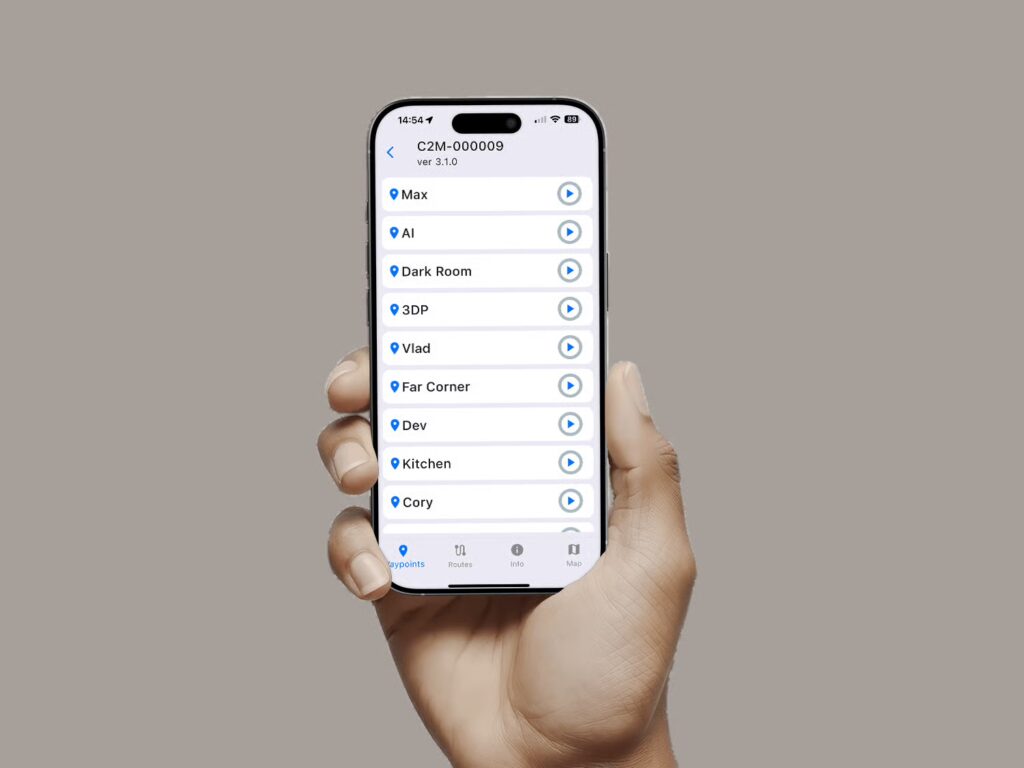
Our Touchscreen: A Window into Q.AI
The Model C2 touchscreen user interface does not sit on top of the robot as an afterthought. It opens a direct window into Q.AI itself.
Every route, waypoint, zone, task, and system state on the screen shows Q.AI making decisions in real time. Operators issue commands naturally, and Q.AI immediately translates that intent into precise control actions.
This tight connection between interface and intelligence delivers a smooth, intuitive experience, even for operators with no robotics background.
Zones Elevators and True Multi-Floor Autonomy
Q.AI provides native support for user definable operational zones, enabling precise control over how autonomous mobile robots behave within a facility.
Supported zones include:
• No go zones
• Traffic lanes
• Speed restricted areas
• Elevator zones
• Automatic door integration zones
Q.AI orchestrates communication with elevators and automatic doors, coordinating calls, door states, and timing to ensure safe and reliable cross floor and multi floor deliveries. This level of integration transforms Model C2 from a single floor robot into a true facility wide automation solution.
Cloud Connect Learning Without Compromising Privacy
While Q.AI operates entirely on the robot, its natural extension is Cloud Connect, Quasi’s secure cloud platform for data aggregation and analysis.
Cloud Connect collects operational data from Model C2 fleets including movement history, distance traveled, time elapsed, task execution, and system health metrics.
This data enables:
• Early predictive maintenance insights
• Intelligent diagnostics
• Performance optimization
• Fleet level analytics
Cloud Connect is designed with privacy by design principles. Data is collected and analyzed responsibly without exposing sensitive customer information.
From the ground up, Cloud Connect is 21 CFR Part 11 compliant, making it suitable for validated environments. Users gain access to reports and dashboards that support accountability, traceability, and audit readiness.
Built-In ROI Accountability
Q.AI continuously generates the data needed to measure real world return on investment. Distance traveled, time saved, utilization rates, and operational history are all recorded and made accessible through Cloud Connect.
This ensures automation decisions are backed by measurable outcomes, not assumptions.
The Road Ahead
Q.AI continues to evolve. As Quasi integrates the knowledge and experience gained from the Model R2 project, new capabilities will flow back into Q.AI, expanding its intelligence, adaptability, and reach.
What remains constant is the philosophy: smart algorithms, engineered for reliability, validation, and real-world performance.
Q.AI is not artificial intelligence for show.
It is intelligence you can trust.
Our Website: https://www.quasi.ai/
Find Us on LinkedIn: https://www.linkedin.com/company/quasi-robotics/