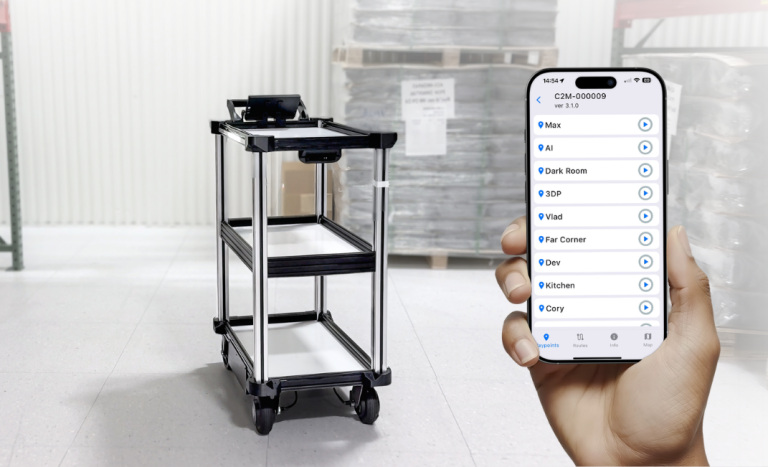

Autonomous robots are often perceived as “black boxes” – machines that simply move from point A to point B. In reality, every movement is the result of a tightly orchestrated system of algorithms working in real time.
At Quasi Robotics, intelligence is not a single monolithic model. It is a coordinated system of specialized algorithms – each responsible for perception, reasoning, and action – working together deterministically on the robot itself.
This article takes you inside that system.
The Architecture of Intelligence
At the core of Quasi AI is an algorithmic intelligence stack, not a purely data-driven neural network. Multiple algorithms, typically 7 to 10, operate in parallel to handle:
- perception
- localization
- motion planning
- obstacle avoidance
- task execution
- safety logic
These components are distributed across microcontrollers and processors, enabling real-time, deterministic decision-making at the edge.
This design philosophy is critical: robots don’t guess – they decide.
Motion Planning: From Intent to Trajectory
Motion planning is the process of transforming a high-level goal into a feasible path.
In robotics, this means computing a trajectory that satisfies:
- kinematic constraints
- dynamic constraints
- safety constraints
- efficiency goals (time, energy, distance)
How Quasi AI Approaches It
When a task is assigned, such as “go to workstation B,” Quasi AI:
1. Maps the environment using LiDAR and sensor data
2. Determines the robot’s current pose (position + orientation)
3. Generates candidate paths through the environment
4. Evaluates paths based on constraints and cost functions
5. Selects the optimal trajectory
The result is not just a path – but a validated, executable motion plan. Unlike probabilistic AI systems, this process is:
- reproducible
- explainable
- testable
Obstacle Avoidance: Real-Time Safety Layer
Factories, labs, and hospitals are dynamic environments. Humans move unpredictably. Objects appear without warning.
Obstacle avoidance is therefore not a one-time calculation, it is a continuous control loop.
Quasi robots combine multi-layer sensing:
- 360° LiDAR for long-range mapping and route planning
- Time-of-Flight (ToF) sensors for short-range detection
- 3D cameras for spatial understanding
How Decisions Are Made
Obstacle avoidance operates at multiple time scales:
- Global layer → avoids congested or blocked routes
- Local layer → reacts to immediate obstacles
- Safety layer → enforces hard constraints (stop, slow, reroute)
For example:
- A blocked aisle → triggers re-routing
- A person stepping in front → triggers immediate deceleration or stop
- A partially obstructed path → triggers micro-adjustments
This layered system ensures both efficiency and safety.
Sensor Fusion: Building a Reliable World Model
No single sensor is perfect.
- LiDAR provides precise distance, but limited semantics
- Cameras provide rich context, but can struggle in lighting variations
- ToF sensors provide proximity, but short range
Sensor fusion combines all of these into a single coherent world model.
Inside Quasi AI
Sensor fusion is handled directly on distributed microcontrollers:
- LiDAR → global map + localization
- ToF → collision envelope
- Camera → 3D context and object awareness
These streams are fused into:
- a continuously updated map
- a real-time obstacle field
- a precise robot pose
Because this happens at the edge:
- latency is minimized
- reliability is maximized
- decisions remain deterministic
The robot doesn’t “see” with one sensor – it understands with all of them together.
Route Optimization: Beyond Shortest Path
Navigation is not just about reaching a destination – it’s about doing it efficiently.
Quasi AI continuously optimizes routes based on:
- congestion levels
- blocked zones
- traffic rules (lanes, speed zones)
- operational priorities
Routes are dynamically updated using live sensor data, with facility maps refreshed regularly to maintain accuracy.
Key Capabilities:
- Dynamic rerouting when conditions change
- Zone-based behavior (no-go areas, restricted speeds)
- Multi-floor navigation with elevator integration
- Fleet-level optimization through cloud analytics
This transforms navigation into a real-time optimization problem, not a static path.
Collision Checking: The Invisible Guardian
Every motion command issued by Quasi AI is validated before execution.
Collision checking ensures that:
- the robot’s footprint remains safe
- planned trajectories are feasible
- dynamic obstacles are accounted for
This happens continuously:
- before motion begins
- during execution
- after every sensor update
If any constraint is violated: → the plan is recalculated instantly
This guarantees fail-safe operation in dynamic environments.
Putting It All Together
What looks simple – a robot moving through a facility – is actually the result of:
- motion planning generating trajectories
- sensor fusion building a world model
- obstacle avoidance reacting in real time
- route optimization improving efficiency
- collision checking ensuring safety
All of this runs simultaneously, across distributed processors, in milliseconds.
Why This Matters
Quasi AI is not built on opaque, probabilistic systems. It is engineered as:
- deterministic → same input, same outcome
- explainable → every decision can be traced
- validatable → critical for regulated industries
- real-time → decisions happen on the robot, not in the cloud
This is what allows autonomous robots to move from demos to mission-critical infrastructure.
Final Thought
Autonomy is not magic. It is architecture. Inside every Quasi robot is a system that continuously answers a simple question:
“What is the safest, most efficient action I can take right now?”
And it answers that question – hundreds of times per second.
Our Website: https://www.quasi.ai/
Find Us on LinkedIn: https://www.linkedin.com/company/quasi-robotics/